
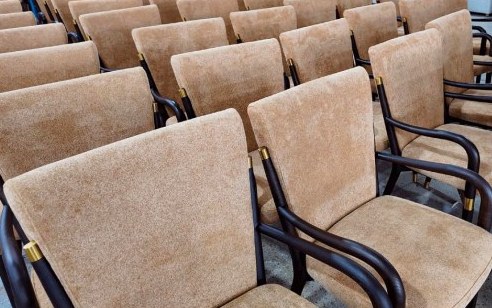
Dining, cafés and hospitality
Restaurant furniture sourcing in China
A dining chair can look right on its own. But what if its arms will not slide under your table? Try the combination, then check how your team will move, clean and maintain it.
What should you check before ordering restaurant furniture?
Start with the seating layout and a short description of a normal service day. Try chairs with their tables, check how staff move and clean them, and approve a physical sample before ordering the batch. Fitted bench seating, loose chairs and outdoor dining each need different measurements, care and installation plans.
Describe a normal service day to the supplier
Your mood board shows the look you want. Add what happens after guests leave: are chairs stacked, floors mopped and tables moved for the next service? Those details help a supplier suggest furniture your staff can live with.
| Think about | Ask yourself | Tell the supplier |
|---|---|---|
| Guests at the table | Quick meals, long dinners or lounge seating? | The comfort you need and whether chair arms must fit under the table |
| Moving and cleaning | Will staff lift, stack or move chairs on trolleys? | How chairs are handled, whether protective feet (glides) can be replaced, and any stacking limits |
| Spills | Which food, drinks and cleaners will touch the furniture? | The cleaning routine; ask for care instructions and a sample to review |
| Changing the layout | Will you join tables for groups or move them for events? | The heights, bases, connectors and storage space that need to work together |
| A terrace or open window | Can rain, sun or coastal air reach the furniture? | The actual exposure, so the construction suits those conditions |
Mark what you can change and what you cannot. A slightly different chair shape may be acceptable; a finish that cannot tolerate your agreed cleaning routine is another matter.
Sit at the table before approving the chair
Ask: “Can we try this chair with the exact table and base being quoted?” Sit down, pull the chair in and check whether arms or knees meet the table supports. Catalogue dimensions do not show every clash.
Then look at the layout with chairs pulled out. Your local designer must check circulation, accessible routes and building requirements. In the U.S., the Access Board's ADA provisions for dining and work surfaces address accessible surfaces, clear floor space and knee and toe clearance. Tabletop height alone does not establish compliance.
Check how tables are levelled on your floor. Try stools against the finished counter, including its underside and foot support. Children’s seating and other specialist products need their own requirements; do not hide them inside a general chair order.

Will this dining set work on a busy day?
Let guests, service staff and the cleaning team’s needs shape the choice, alongside the look of the room.
Try the chair and table together
Sit down, pull the chair in, then think about moving and cleaning the set after service.
Can guests use it comfortably?
Review seat position, arm clearance, table supports and the layout with chairs pulled out.
Can staff reset the room?
Demonstrate the planned lifting, moving, stacking or storage method using the supplier’s instructions.
Can housekeeping clean it?
Check surfaces, seams, crevices and removable parts against the operator’s actual cleaning routine.
Can worn parts be replaced?
Identify glides, feet, seat pads and fixings by stable reorder references.
Keep in mindBring an operator, service team member, housekeeping representative and designer into the same sample review.
These are operational review questions, not a substitute for required product tests or a local accessibility review.
Choose a finish your team can clean
“Performance fabric” does not tell housekeeping which cleaner to use. Ask for the exact fabric, wood or board beneath the surface, finish and care instructions for the proposed piece.
Look where food and wear are likely to leave their mark, not only at the centre of a new tabletop:
- Tabletops: edges, joints, underside fixings and protection against spills.
- Upholstery: seams that collect crumbs and whether covers or pads come off.
- Frames: joints and replaceable feet or floor-protecting glides.
- Mixed materials: a cleaning method suitable for the whole piece.
With the material supplier’s guidance, try the operator’s cleaner on an agreed sample or offcut. Record the product, dilution, method and result. This practical check does not replace required laboratory tests.
For a terrace, also describe sun, rain and moisture. The outdoor furniture sourcing guide covers those questions.
Measure fitted bench seating against the finished room
A banquette is bench-style seating, often fitted along a wall. Length alone is not enough: agree the seat and back shape, sections, seams, end panels, base and removable access panels. Confirm whether it is fixed or freestanding and who installs it.
Ask the site team to check finished dimensions, including columns and power points. If the supplier must start before the room is ready to measure, agree what can be adjusted and who accepts the risk. A drawing cannot confirm an unmeasured wall.
Have the project’s qualified adviser define the fire-performance evidence for upholstered seating. In the U.S., CPSC guidance on upholstered furniture helps assess covered products; it is not a complete restaurant approval. Local building-use requirements and other product obligations need separate review.
Finally, ask how an upholstered panel comes off for cleaning or replacement. You want to know before the bench is fitted against the wall.
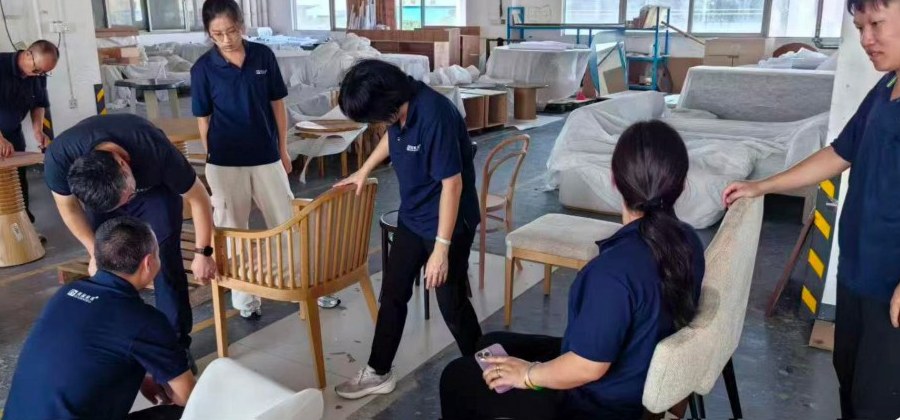
Let the people running the restaurant try the sample
The designer may like the chair while the service team finds it awkward to move. Invite an operator, service staff and housekeeping to review it together. Keep one written decision sheet so approval of the look is not mistaken for approval of everything.
- Note the model, finish and any changes from the quotation.
- Sit at the intended table.
- Try the agreed moving, stacking and storage method.
- Check cleaning access and removable parts.
- List what is accepted, what needs correcting and what evidence is missing.
Do not improvise destructive load tests or treat this trial as certification. Request the specified strength, stability or durability evidence separately. Keep the approved sample—or detailed agreed records—so inspectors do not have to rely on memory.
The supplier verification guide helps connect that sample to the workshop making your order.
Check the batch—and ask about replacement parts
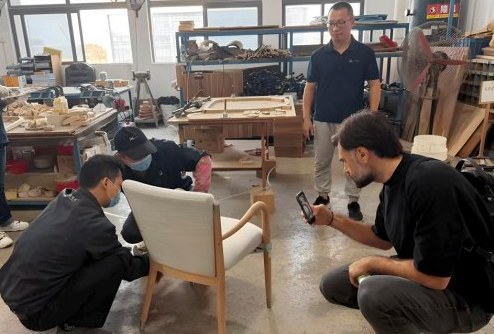
Put finished pieces next to one another when checking the order. Compare wood colour, upholstery and the fit of interchangeable parts across the batch, not only on one chair.
Ask for the minimum order quantity, or MOQ, for each model, material and finish. A stocked chair and a custom fabric version may have different minimums. Sharing a container does not automatically remove them.
List likely replacement parts: glides, levelling feet, seat pads, fixings and suitable touch-up materials. Agree quantities with the operator and supplier rather than adding the same spare percentage to everything. Keep reorder codes and ask what happens if a finish is discontinued.
For a restaurant within a larger development, use the contract project framework to coordinate shared finishes and deliveries.
Know who will assemble the tables before they arrive
Confirm whether tables arrive assembled or with tops and bases separate. Ask for instructions, labelled hardware and a tool list. Name the person who will assemble them and check the result.
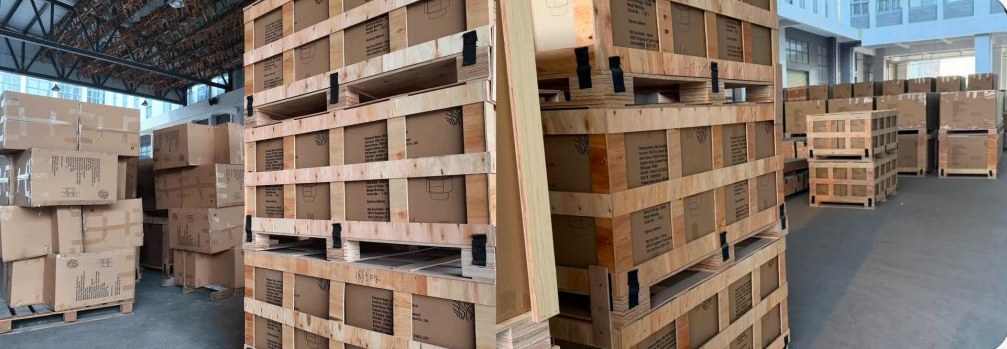
Mark cartons by model, finish and component count. Check the unloading route, clean storage and packaging disposal. If construction is still under way, agree how the furniture will be protected before arranging delivery.
Report shortages, damage and assembly problems through the agreed process, using carton numbers and photographs. The guide to buying furniture from China explains the wider order and shipping process. Ratahome can discuss buying and coordination help; the agreement must define the services and local responsibilities.
Buyer questions
Practical questions, answered
Can I mix restaurant chair and table models in one order?
Often worth asking, but each supplier sets minimum quantities by model and finish. Compare the cost of the complete mix, including packing together, freight and assembly—not only the chair prices.
How do I choose easy-clean restaurant upholstery?
Tell the supplier which spills and cleaning products the restaurant expects. Ask for the exact fabric and care instructions, then review seams, removable parts and an agreed sample cleaning check. The words easy-clean are not enough on their own.
Should banquettes be measured before ordering?
Yes. Check the room dimensions and how the seating meets walls, columns and adjacent furniture. If manufacture must start earlier, agree what can be adjusted and who accepts the risk of unfinished measurements.
Can indoor restaurant furniture be used on a covered terrace?
Do not assume so. A roof may still allow humidity, wind-driven rain, sunlight or salt to reach it. Describe those conditions and ask for evidence and care instructions for that use.
Want to check the details?
Official sources and notes
The examples are for planning, not quotations or past client projects. Photos illustrate the subject; they do not prove factory ownership or product certification. Check current requirements and dates with the relevant authority or organiser.
- U.S. Access Board: ADA Accessibility Standards — Sections 902, 305 and 306 address accessible dining surfaces and associated clearances in their applicable U.S. context.
- CPSC: Upholstered Furniture — Check product scope and U.S. requirements with the project adviser.
Have a project in mind?
Tell us what you need, where it will be delivered and when you need it. A furniture list or a few reference photos is a useful place to start.
Ratahome helps coordinate suppliers, samples and delivery in Foshan. We work with manufacturers; we do not manufacture the furniture ourselves.
Talk about your project